AI automation for a small business means handing repetitive, rules-based work to software that can read, write, sort and respond on its own, so your team stops doing it by hand. In practice that looks like a website chatbot answering common questions at 11pm, an email sequence that follows up leads without anyone hitting send, and admin jobs like sorting enquiries or drafting replies happening in the background. You do not need a data team or a big budget to start. You need one painful, repetitive task and a sensible first automation to take it off your plate.

Key takeaways
- AI automation is about outcomes, not tools: fewer missed enquiries, faster replies, less manual admin.
- Start with one high-volume, low-judgement task (after-hours enquiries and lead follow-up are the usual winners).
- Costs vary by scope; DomainFX works to a contact-for-quote model rather than fixed shelf pricing.
- Under Australian law, most businesses handling personal information should still follow the Australian Privacy Principles even when the small-business exemption applies.
- A good partner shows you the workflow and the guardrails, not just a demo.
What actually counts as AI automation for a small business?
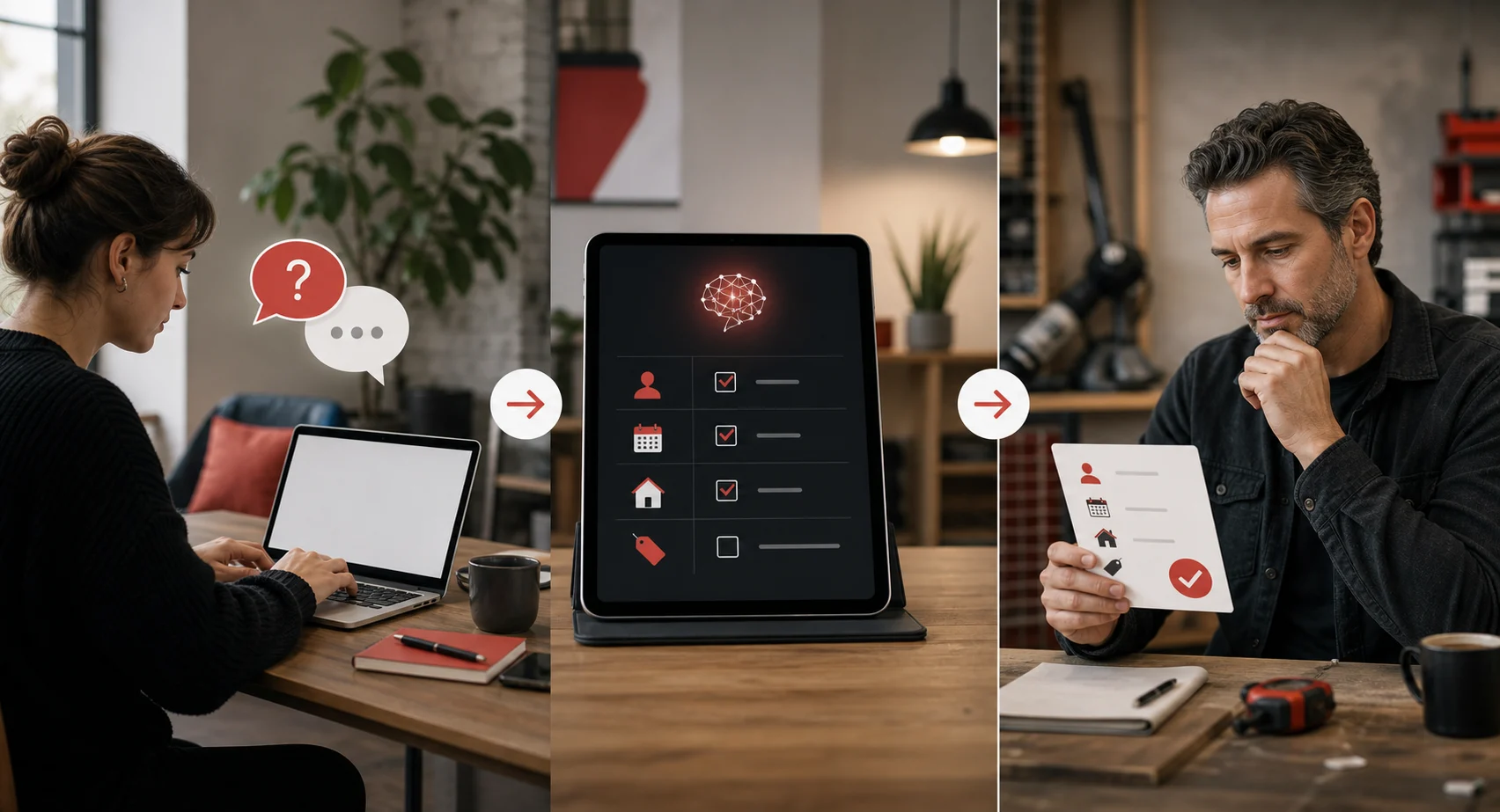
AI automation is software that handles a task from start to finish using AI to understand messy, human input. That last part is the difference from old-school automation. A booking form that emails you a notification is automation. A chatbot that reads a customer’s typed question, works out they want a quote for a bathroom reno, collects their suburb and budget, and drops a qualified lead into your inbox is AI automation. It deals with language and intent, not just tick-boxes.
For a small business the useful mental model is a junior assistant who never sleeps and never forgets. It is very good at high-volume, repeatable work with clear boundaries: answering FAQs, tagging enquiries, drafting first-pass replies, chasing quotes, posting to social on a schedule. It is not a replacement for judgement, and it should not be making final calls on anything sensitive. The wins come from removing the 40 small tasks a week that eat your evenings, not from replacing a person.
Where should a small business start with AI?
Start with the task that costs you the most enquiries or the most hours, and has the least judgement involved. For most SME owners in South East Queensland that is after-hours lead capture. If people land on your site at night or on the weekend and there is no way to get an answer, a chunk of them leave and call the next business. A website chatbot plus live chat closes that gap without hiring anyone.
A simple way to pick your first automation:
- List the five tasks your team repeats most in a week.
- Cross off anything that needs real human judgement or a licence.
- Of what is left, pick the one that either loses you money when it is slow (enquiries) or eats the most hours (admin).
- Automate that one thing well before adding a second.
Resist the urge to automate everything at once. One reliable automation that works beats five half-built ones you have to babysit.
Which use cases give small businesses the best return?
Four areas do most of the heavy lifting for an SMB. Here is where each one pays off and what to watch for.

| Use case | What it does | Best fit | Watch for |
|---|---|---|---|
| Customer support and lead capture | Answers FAQs, qualifies enquiries, books calls 24/7 | Service businesses that lose after-hours leads | Keep answers accurate; hand off tricky questions to a human |
| Marketing automation | Email nurture, scheduled social posts, follow-ups | Businesses with a list they never email | Sounding robotic; set the tone and review sequences |
| Custom AI assistants | A custom GPT trained on your own info and policies | Teams answering the same internal or customer questions daily | Feeding it accurate, current source material |
| Back-office admin | Sorting enquiries, drafting replies, data entry | Owners drowning in inbox and paperwork | Over-automating approvals; keep a human in the loop |
Customer support and lead capture is almost always the first place to spend money, because a missed enquiry is lost revenue you can measure. Marketing automation is the second, because most small businesses sit on a customer list they rarely contact, and re-engaging past customers is cheaper than finding new ones.
What does AI automation realistically cost, and what should you expect?
Costs depend on scope, not on a shelf price. A single website chatbot with a set list of answers sits at the low end. A marketing automation setup with multi-step email sequences, or a custom assistant trained on your own documents, sits higher because there is real configuration behind it. DomainFX works to a contact-for-quote model for this reason: the honest answer depends on what you are automating and how much of your existing process needs to be mapped first.
Set expectations on two fronts. First, automation needs a short setup and tuning period. The first few weeks are for correcting answers, adjusting tone, and closing gaps, not for walking away. Second, measure the right thing. For lead capture, track enquiries captured after hours and how many turn into jobs. For marketing, track opens, replies, and re-engaged customers. If you cannot point at a number that moved, the automation is decoration.
What are the privacy rules for AI in Australia?
If your automation collects customer names, emails, phone numbers or enquiry details, you are handling personal information, and Australian privacy law applies to how you collect, store and use it. The framework is the Privacy Act 1988 and the Australian Privacy Principles, overseen by the Office of the Australian Information Commissioner (Privacy Act 1988 (Cth) sch 1). Many small businesses with annual turnover under a set threshold are exempt from parts of the Act, but there are important exceptions, and following the Principles is still the sensible default (Privacy Act 1988 (Cth) s 6D).
Practical steps that keep you on the right side of it:
- Tell people what you collect and why, in plain language on the page where a chatbot or form sits.
- Only collect what you actually need to answer the enquiry or deliver the service.
- Check where your tool sends and stores data, especially if it goes offshore, and confirm it is handled securely.
- Give customers a real person to reach and a way to have their data removed.
This matters more as AI answers become the front door to your business. When a customer types their details into your chatbot, they are trusting you with them the same way they would on a contact form.
How do you choose an AI automation partner?
Pick a partner who shows you the workflow and the guardrails, not just a slick demo. A demo proves the tool can talk. What you actually need to see is what happens when a customer asks something off-script, how the system hands off to a human, where your data goes, and how answers stay accurate over time. Ask them to walk you through a real example end to end.
Good signs to look for:
- They ask about your process and your worst repetitive tasks before pitching a tool.
- They are clear about what AI should not handle in your business.
- They set up measurement from day one, so you can see what the automation actually changed.
- They are local enough to understand your market and reachable when something needs adjusting.
DomainFX is based in Ormeau and works with small businesses across Brisbane, the Gold Coast and wider South East Queensland, so the same team that builds your automation is the one you can call when you want to tweak it.
Frequently asked questions
Will AI automation replace my staff? Not for a small business. It removes repetitive, low-judgement tasks so your team spends time on work that needs a human. The usual result is fewer missed enquiries and less after-hours admin, not fewer people.
How long before it works properly? Plan for a short tuning period. The tool goes live quickly, but the first few weeks are for correcting answers and adjusting tone before it runs cleanly on its own.
What is the difference between a chatbot and a custom GPT? A standard chatbot answers from a set list of responses. A custom GPT is trained on your own information and policies, so it can answer more naturally about your specific business. The custom GPT guide above covers when each one fits.
Is my customer data safe with an AI tool? It depends on the tool and how it is set up. Check what is collected, where it is stored, and whether it goes offshore, and make sure you follow the Australian Privacy Principles when handling personal information.
Ready to take one task off your plate?
Pick the one repetitive job costing you the most enquiries or hours, and let us build the automation for it. To talk through the highest-return option for your business, see the Small Business AI Automation Services page, or contact DomainFX on (07) 3804 7752 for a straight-talking quote.