
An AI chatbot captures after-hours enquiries by answering common questions and collecting the visitor’s name, contact details and reason for enquiry the moment they land on your site, then handing that lead to you as an email or notification for follow-up the next morning. For a small business that can’t staff a phone line at 9pm on a Sunday, that means the enquiry that would have bounced to a competitor instead sits in your inbox ready to quote.

Key takeaways
- A chatbot works nights and weekends, so enquiries that arrive outside business hours get answered instead of lost.
- Its main job for most SMBs is lead capture, not perfect conversation: collect the name, contact and question, then route it to a human.
- A chatbot beats a contact form when the visitor has a question first; a form beats a chatbot when they already know exactly what they want.
- Pair an automated chatbot with live chat so a real person can jump in during business hours.
- Feed it your real FAQs, service list and pricing rules so answers are accurate, and always give people an easy path to a human.
What does an AI chatbot actually do for customer service?
It handles the repetitive first layer of every enquiry so you don’t have to. Most questions a small business gets are the same handful over and over: do you service my suburb, what does it cost roughly, are you open Saturday, how long is the wait, can I book online. A chatbot answers those instantly, day or night, and for anything it can’t answer it takes the person’s details and tells them when to expect a reply.
The important shift is what it does with an enquiry it can’t resolve. A good SMB chatbot isn’t trying to be a know-it-all. When it hits the edge of what it’s been given, it collects a lead: “I’ll get Michael to call you back, what’s the best number and a quick note on what you need?” That turns a dead-end into a booked follow-up. The conversation log arrives with the contact details, so you already know what the person wants before you pick up the phone.
Why after-hours enquiries matter more than most SMBs think
A large share of web traffic to small business sites lands outside standard business hours: evenings after work, lunch breaks, weekends. Someone searching for a plumber at 9pm with a leaking hot water system, or comparing three cafés for a Saturday function on Friday night, is a ready-to-act enquiry. If your only response option is a contact form that promises a reply “within 1-2 business days”, that person has moved on before you open on Monday.

Google’s Business Profile and search results now surface competitors side by side, so the friction of waiting is real: the visitor simply clicks the next result. A chatbot closes that gap by responding in the moment. It doesn’t need to close the sale at 9pm; it needs to acknowledge the person, answer their first question, and secure their details so the enquiry is still alive in the morning. For SE Queensland trades, hospitality and service businesses, where after-hours and weekend demand is a real chunk of the pipeline, that difference compounds week after week.
When does a chatbot beat a contact form (and when doesn’t it)?
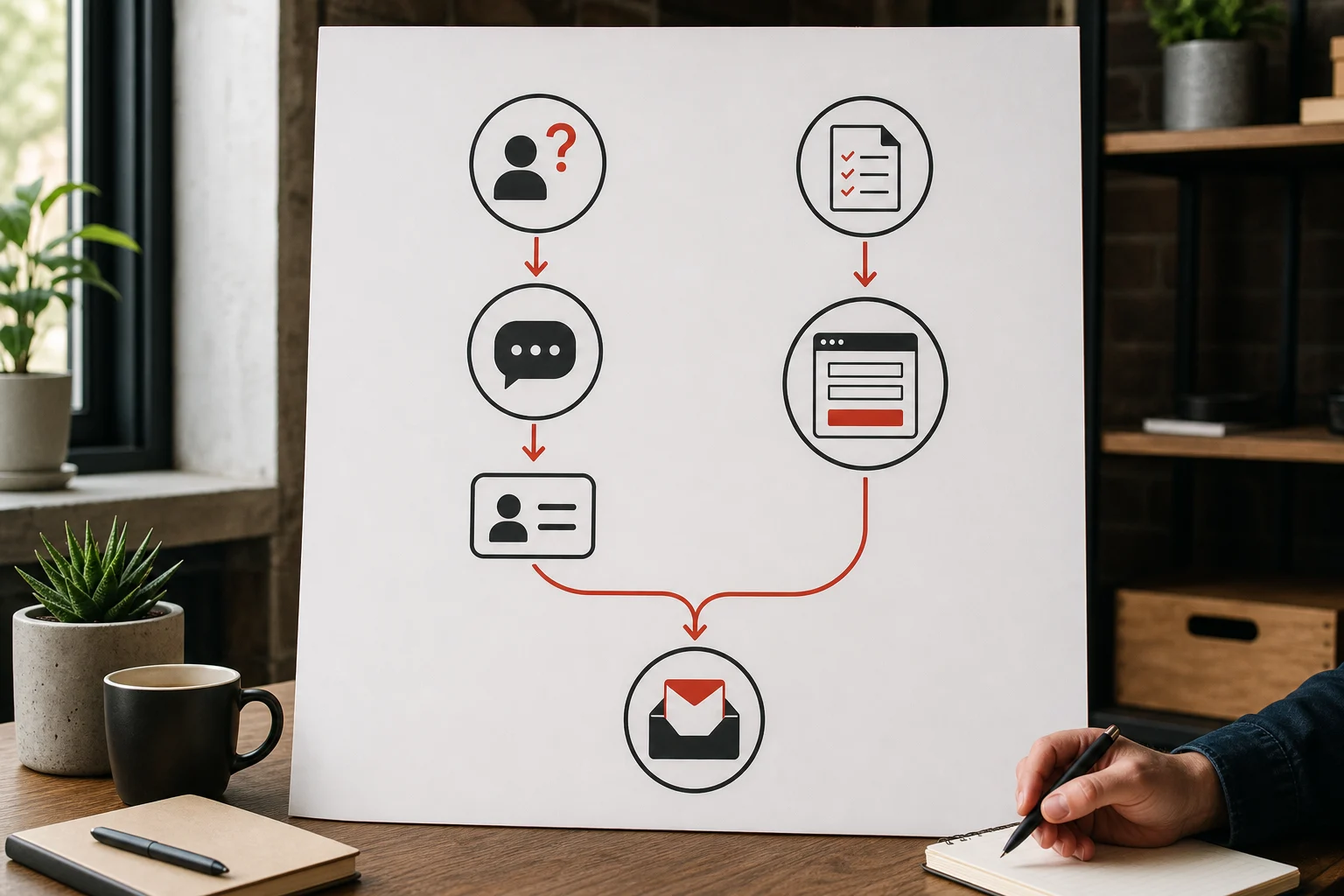
A chatbot wins when the visitor has a question before they’re ready to commit. A form assumes the person already knows what they want and is happy to fill in fields and wait. Plenty of visitors aren’t there yet: they want to check one thing first (do you even do this, is it in my budget, can you come to Ormeau) before handing over their details. A form makes them guess; a chatbot answers, then captures.
Here’s the practical split:
| Situation | Better tool |
|---|---|
| Visitor has a quick qualifying question first | Chatbot |
| Visitor is browsing at night or on the weekend | Chatbot |
| Visitor wants an instant answer to an FAQ | Chatbot |
| Visitor already knows they want a detailed quote | Form (or chatbot that hands off to a form) |
| Long, structured intake with documents/attachments | Form |
| Simple “email us” fallback for people who dislike chat | Form |
You don’t have to choose one. The strongest setup runs both: a chatbot for the visitors who want to ask before they act, and a form for the ones who prefer to fill in details and hit send. The chatbot can even complete the form on the visitor’s behalf through the conversation.
Chatbot vs live chat: what’s the difference and why run both?
An AI chatbot is automated and always on; live chat puts a real person in the conversation. They solve different halves of the same problem. The chatbot covers the hours you’re not at the desk and handles volume without tying up a staff member. Live chat lets you or your team step into a conversation during business hours when a question needs a human answer or a lead is worth a personal touch.
Run both and the handover is the point: the bot fields the first message, and if you’re online and it’s a good lead, you take over mid-conversation. If you’re not, the bot keeps going and books the callback. DomainFX offers an automated website chatbot for the 24/7 layer and a free website live chat for the human layer, so you can start with one and add the other as it makes sense.
What do you need to set one up properly?
Four things, in order of importance:
- Your real FAQs and answers. The bot is only as good as what you feed it. Write down the ten questions you actually get most, with the answers you’d give on the phone. This is the single biggest driver of quality.
- Clear service and area boundaries. Tell it what you do and don’t do, and where you work. A chatbot that confidently books a job outside your service area wastes everyone’s time.
- Pricing rules, not fake prices. You don’t need to publish exact figures. Give it the logic: “quotes start from an on-site inspection”, “call-out applies outside Brisbane and the Gold Coast”, “prices depend on X and Y”. Honest ranges beat invented numbers.
- A lead-capture and handoff path. Decide what details it must collect (name, phone or email, and the reason for enquiry) and where those go: your inbox, a notification, or your booking system. Always include an easy “talk to a human” exit.
Keep the scope tight at launch. A chatbot that reliably answers your top ten questions and books callbacks beats one that tries to answer everything and gets things wrong. Review the conversation logs in the first few weeks, spot the questions it fumbled, and add those answers. That feedback loop is where a chatbot goes from useful to genuinely valuable.
What are the common mistakes SMBs make with chatbots?
The big one is letting the bot guess. If it isn’t told a price, it should say “I’ll get you an accurate quote” rather than invent a figure. Guardrails matter: the bot should stay inside what it knows and hand off cleanly when it doesn’t. This is the same discipline that matters for any business-specific AI assistant, which we cover in our guide to custom GPTs for small business.
Other frequent misses:
- No human exit. Some people just want to talk to you. If there’s no obvious way through, they leave frustrated.
- Hiding it or making it too loud. A widget that ambushes every visitor with a pop-up on load annoys people; one buried in the footer never gets used. Bottom-corner, visible, one gentle prompt.
- Set and forget. A chatbot needs a review of its logs every so often to catch new questions and fix wrong answers. It’s a tool you tune, not a switch you flip.
- Ignoring privacy. If it collects names, phone numbers and enquiry details, that’s personal information and it should be handled in line with Australian privacy obligations (Privacy Act 1988 (Cth)). Be clear about what you collect and why, and don’t retain more than you need.
This chatbot piece is one part of a broader picture. If you’re weighing up where automation actually pays off across your business, start with our practical guide to AI automation for Australian SMBs.
Talk to DomainFX about capturing after-hours enquiries
DomainFX is based in Ormeau and works with small and medium businesses across Brisbane, the Gold Coast and SE Queensland. We set up website chatbots and free live chat that answer the questions your customers actually ask and get their details into your inbox, whatever the hour. If you want to stop losing evening and weekend enquiries, call us on (07) 3804 7752 or get in touch through our contact page and we’ll talk through what fits your business.