
Marketing automation lets a small business set up email sequences, social posts and follow-ups once, then let software send them on the right trigger or schedule so you stop doing the same manual tasks every week. For a typical SME the biggest wins are automated email nurture (welcome and follow-up sequences), scheduled social posting, and killing repetitive admin like tagging contacts and chasing quotes. You do not need a big martech budget or a full-time marketer to get value: you need a handful of well-chosen automations tied to things you already do.
Key takeaways
- Automation replaces repetitive tasks (sending, scheduling, tagging, reminding), not the thinking or the relationship.
- The three highest-ROI starting points for most SMBs: a welcome email sequence, a lead follow-up sequence, and a social scheduling queue.
- Start with one workflow that saves you time this week, then add more. Don’t buy a platform and try to automate everything at once.
- Australian email marketing is governed by the Spam Act (Spam Act 2003 (Cth)), so consent and a working unsubscribe are non-negotiable.
- Measure a small set of numbers (open rate, reply/booking rate, time saved) so you know what’s actually working.
What can a small business actually automate?
The realistic list is narrower and more useful than the hype suggests. You can reliably automate the repeatable, rule-based parts of marketing:

- Email sequences: welcome emails, lead follow-ups, quote reminders, review requests, re-engagement for old contacts.
- Social posting: queueing and scheduling posts across your channels so they go out consistently instead of whenever you remember.
- Contact admin: tagging and segmenting people based on what they did (downloaded a guide, booked a call, went quiet), so the right message reaches the right group.
- Internal notifications: a Slack or email ping when a hot lead fills in a form, so nobody slips through.
What you should not try to automate is the judgment and the voice. A booking that needs a real answer, a complaint, a tricky quote: those still want a human. Automation is there to buy back the hours you currently lose to copy-paste work, not to run your marketing on autopilot.
Where should an SMB start? (the three workflows that pay off first)
Start with the workflow that saves you the most time for the least setup. For most South East Queensland small businesses that means these three, roughly in order.
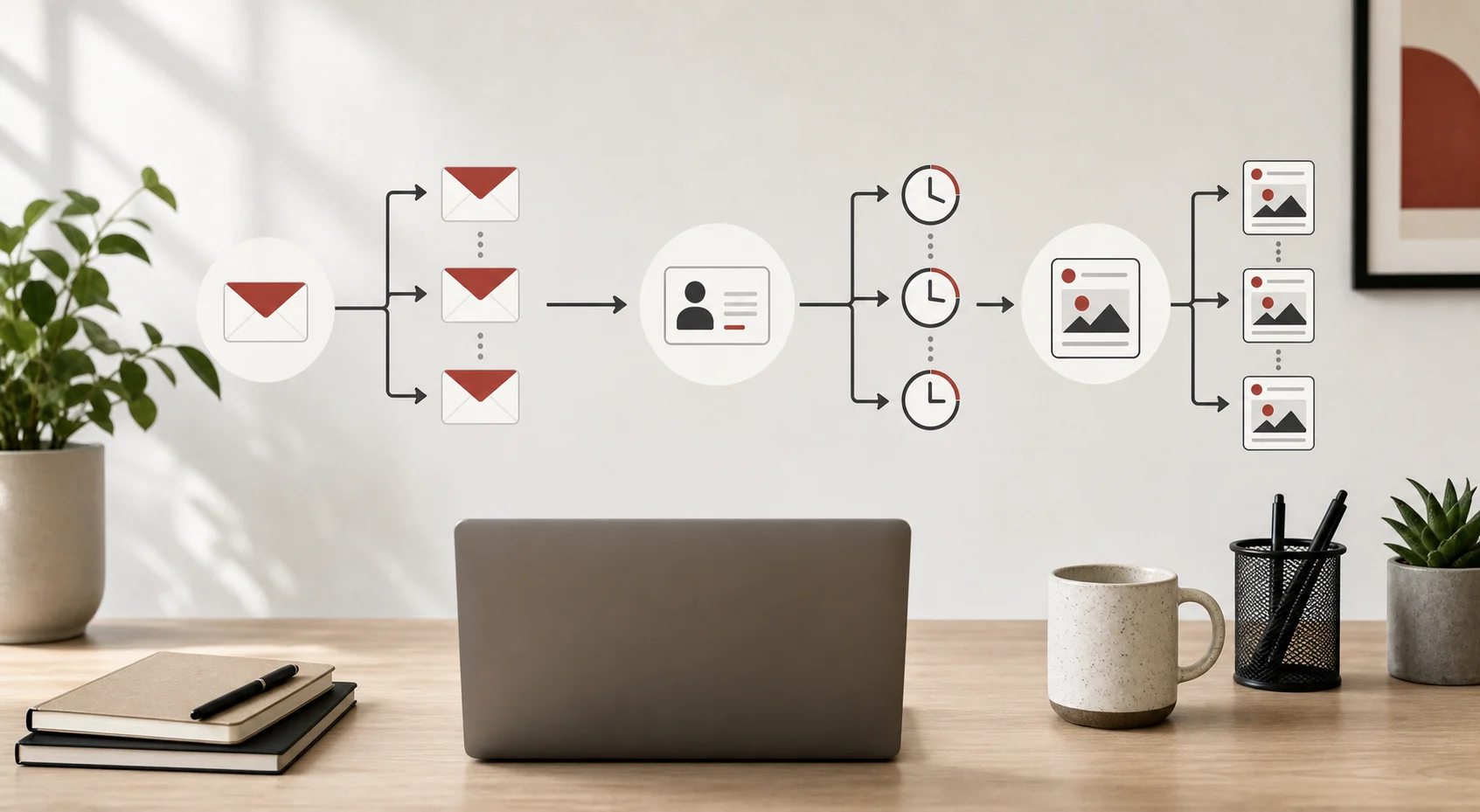
1. A welcome sequence. When someone subscribes, books, or buys, three or four automated emails over a couple of weeks do the introducing you would otherwise do by hand: who you are, what to expect, how to get help, and a soft nudge to the next step. Set it once and every new contact gets a consistent first impression.
2. A lead follow-up sequence. Most enquiries that go cold do so because nobody followed up a second or third time. A short automated sequence (a same-day thank-you, a two-day “any questions?”, a one-week check-in) recovers leads you are already paying to generate. This is usually the single most profitable automation for a service business.
3. A social scheduling queue. Batch your posts once a fortnight, load them into a scheduler, and let them publish on a set rhythm. You get consistency without the daily scramble, and you free up the mental load of “have I posted this week?”
Nail these three before you touch anything fancier. If you also run a website chatbot or live chat to capture enquiries, your follow-up sequence gives those new leads somewhere to go.
How does marketing automation actually save time?
It saves time by removing the small tasks you repeat, not by doing your marketing for you. Think about the follow-up email you retype for every enquiry, the review request you keep meaning to send, the social post you write at 9pm because you forgot. Each is a few minutes; across a month they add up to hours. Automation does the sending and the timing; you do the writing once.

A useful way to spot candidates: for a week, note every marketing-related task you do more than twice. Anything that appears on that list with the same steps each time is an automation candidate. The repetitive, rule-based ones convert cleanly. The one-off, judgment-heavy ones don’t, and that’s fine.
What does it cost, and what’s realistic for an SMB?
Costs vary widely because “marketing automation” spans free schedulers up to enterprise platforms, so the honest answer is: it depends on the tools and how much is built for you. What is realistic to expect:
- You can start with a single email tool and a single social scheduler, not a giant all-in-one suite.
- The bigger cost is usually setup and thinking, not the monthly software fee. Getting the sequences, triggers and copy right is where the value is.
- Returns show up as recovered leads and reclaimed hours, not a headline number on day one. Give a new sequence a few weeks of real traffic before you judge it.
Be sceptical of anyone promising a specific percentage lift from automation alone. The lift comes from doing the follow-up you weren’t doing before, done consistently.
What are the rules for email marketing in Australia?
Australian commercial email is regulated by the Spam Act, and the three obligations that matter for automation are consent, identification, and an unsubscribe that works (Spam Act 2003 (Cth)). In plain English:
- Consent: only email people who have agreed to hear from you, or who have a clear existing relationship with your business. Buying a list is a fast way to land in trouble and in spam folders.
- Identify yourself: every message makes clear who it’s from and how to reach you.
- Unsubscribe: every commercial email carries a working opt-out, and you action it promptly.
Automation makes compliance easier when it’s set up right, because the unsubscribe and the record of consent are handled by the tool. It also makes non-compliance faster if you point a sequence at contacts who never opted in. Set the guardrails once, at the start. Personal information you collect is also covered by the Privacy Act (Privacy Act 1988 (Cth)), so store contact data carefully and only use it for what people agreed to.
How do you keep automated marketing from sounding like a robot?
Write the automation in your own voice and keep it useful, not salesy. The messages people resent are the ones that feel mass-produced and only ask for something. A few habits that keep automated marketing human:
- Use a real reply-to address and let people respond to a person.
- Write like you’d talk to a customer, not like a newsletter template.
- Segment so the message fits the moment. A new subscriber and a five-year customer shouldn’t get the same email.
- Cap the frequency. More emails is not more results; relevance is.
Consistency plus genuine usefulness is what makes automation work. The tool handles the timing; you’re still responsible for having something worth saying.
How do you measure whether it’s working?
Track a small set of numbers rather than a dashboard full of them. For most SMBs the ones that matter are:
| What to measure | Why it matters |
|---|---|
| Open rate | Tells you if subject lines and sender reputation are healthy |
| Reply / booking / click rate | The real signal that the email drove an action |
| Unsubscribe rate | A rising rate means you’re emailing too often or the wrong people |
| Time saved per week | The whole point: hours you got back |
Review these monthly, change one thing at a time, and keep what works. If a sequence isn’t earning its place, cut it. This ties into your wider SEO and content marketing numbers, since email and social both feed traffic and repeat visits back to your site.
Where marketing automation fits with the rest of your AI setup
Email and social automation is one piece of a broader picture. It works best alongside lead capture at the front door and follow-through after the enquiry. If you want the fuller view, our practical guide to AI automation for Australian SMBs covers where to start across customer support, lead capture and admin. For capturing enquiries in the first place, see how SMBs use AI chatbots to catch after-hours enquiries, and if you want an assistant that knows your business inside out, read about custom GPTs for small business.
Get marketing automation set up without the guesswork
DomainFX is a web design, SEO and digital marketing team based in Ormeau, working with small and medium businesses across Brisbane, the Gold Coast and the rest of South East Queensland. We set up marketing automation the practical way: start with the one or two workflows that save you time now, wire them into your website and enquiries, and keep the setup honest about what it will and won’t do.
Marketing automation is part of our small business AI automation services. To talk through what would help your business, contact DomainFX or call (07) 3804 7752 for a no-pressure consultation.